

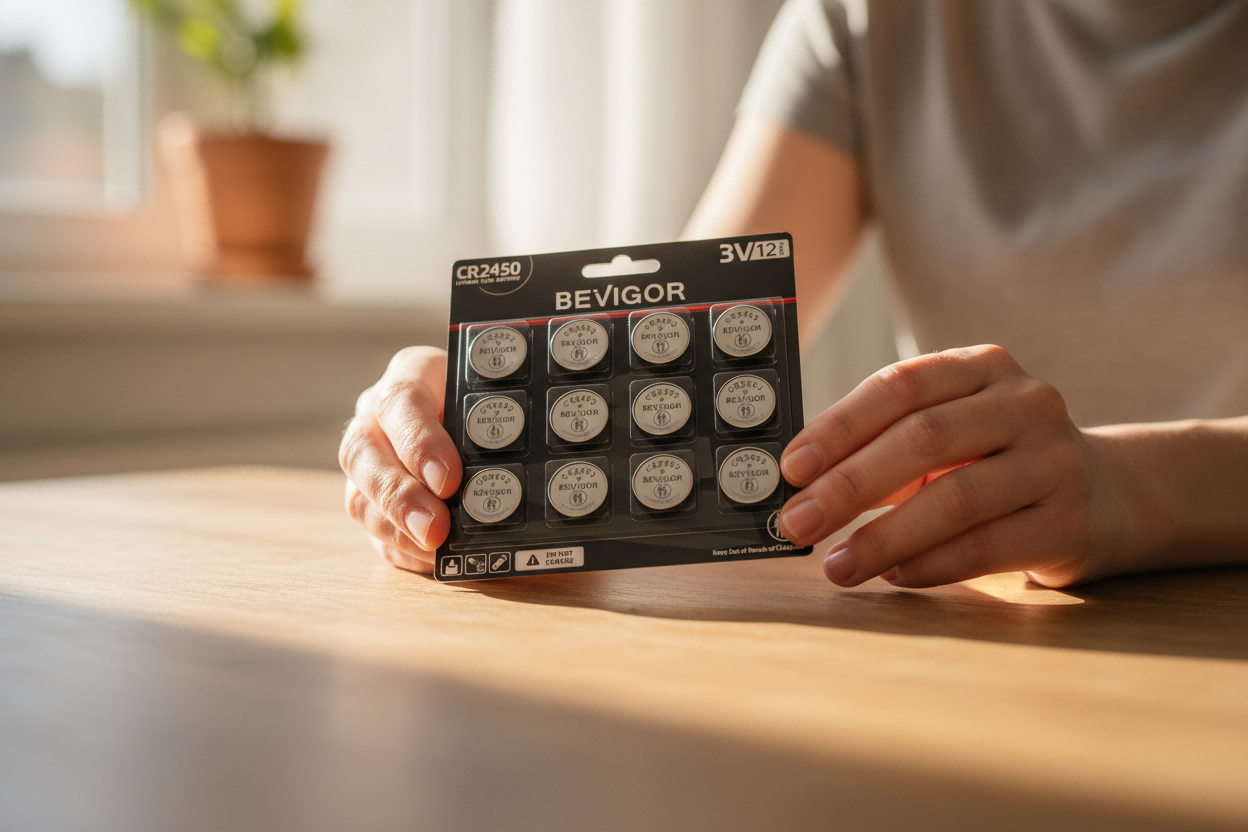
The U.S. Consumer Product Safety Commission (CPSC) enforces strict standards under Reese's Law, mandating child-resistant packaging for all coin- and button-cell batteries to prevent accidental childhood ingestions. While this regulation is vital for protecting children from severe internal chemical burns, the heavy plastic laminates pose significant physical challenges for seniors or anyone living with arthritis.
At Bevigor, we believe that safety and accessibility can coexist. By adopting an organized approach to battery replacement, you can navigate these compliance-related security barriers without letting small batteries slip out of your control.

1. Setting Up a Dedicated "Button Cell Battery" Opening Zone
Opening a child-resistant battery package should never be handled as a casual, on-the-go chore. When slicing through a heavy blister pack, the tiny power cell can unexpectedly shift or slide completely out of sight. If small children or pets live in your home, opening any miniature power cell must be treated as a controlled activity.
Before touching the packaging, take thirty seconds to establish a dedicated, secure workstation. Find a cleared, stable table or a flat countertop rather than an unstable surface like a couch or bed. Ensure the workspace has bright, direct lighting so you can clearly see the lines printed on the secure backing material.
To maximize security, always work over a shallow plastic tray, a rimmed ceramic plate, or a wide kitchen bowl. This container serves as a physical basin to trap the cell if it slips from your fingers. Finally, turn off any nearby desk fans or ceiling fans; moving air can cause lightweight lithium cells to skitter away. This proactive setup prevents the common hazard of dropping and losing track of a loose cell when a child is nearby.
2. Safe Tool Selection for Opening a Tough Button Cell Battery
Because compliant laminates are explicitly engineered to resist tiny fingernails and teeth, attempting to rip them open with bare hands is frustrating. For seniors or adults dealing with joint inflammation, forcing a plastic cap open by hand can cause sudden hand fatigue or painful joint flare-ups. Instead, rely on the mechanical leverage of specialized household tools.
A pair of precision micro-tip scissors or a heavy-duty utility craft knife will give you the clean cutting control needed to bypass reinforced backings safely. When utilizing sharp blades, always cut slowly and slice cleanly away from your body to prevent accidental slippage.
|
Recommended Tool Type |
Best Structural Application |
Primary Safety Advantage |
|
Micro-Tip Craft Scissors |
Cutting along the designated dotted security lines |
Provides fine mechanical leverage for weak grips |
|
Utility Knife / Box Cutter |
Scoring heavy perimeter plastic seals |
Cleanly penetrates thick, puncture-resistant backings |
|
Magnifying Desk Lamp |
Illuminating small warning text and cut icons |
Reduces eye strain and prevents accidental finger cuts |
For individuals managing severe arthritis, a heavy-duty pill-pack splitter or a dedicated sliding blister cutter provides an exceptionally stable, grip-friendly alternative. These accessible tools keep your fingers completely isolated from the sharp edges of the sliced plastic, letting you safely break down the child-resistant barrier without over-exerting your hands.
3. Controlling the Flight of a Button Cell Battery Pack
The most unpredictable moment of the replacement process occurs when the internal metallic cell finally breaks free from its tight plastic pocket. Because child-resistant blister trays are tightly heat-sealed, they build up physical tension as you press down or cut through the perimeter layers. If the plastic gives way suddenly, it can create a spring-loaded effect that launches the miniature battery into the air.
To systematically eliminate this hazard, always face and angle the front of the blister pack directly down into your shallow tray or catching bowl. As you make your final cut through the sealing layer, lightly drape your palm over the open area. You do not need to press hard; use the flat of your hand as a protective physical shield to intercept the cell if it pops upward.
My colleague Monica recently related her experience with this exact issue while working with some seniors. She noted that when helping an older client open a stiff, compliant package with scissors, the slick little battery suddenly shot sideways, bounced off the table, and rolled under a heavy storage cabinet.
To prevent this sort of frantic, unexpected hunting, slice through the reinforced backing slowly and mindfully. Stop cutting the very millisecond you can peel back just enough flexible plastic to get a firm, secure thumb-and-forefinger grip on the rim of the battery. Gently pulling the cell out by its edges keeps it fully under your physical control and safely prevents it from flying across the room.
4. Why You Must Never Pre-Open a Button Cell Battery for Convenience
When regularly managing complex devices—such as modern hearing aids, digital glucometers, or smart home security fobs—it can be tempting to open an entire battery strip all at once. Caregivers frequently turn to this tactic during a quiet afternoon to save an older relative with stiff joints from having to battle tough, compliant packaging later in the week.
Despite the good intentions behind it, pre-opening your power cells creates two major household safety hazards. First, removing the factory-sealed child-resistant backing leaves small, highly corrosive objects completely exposed. Loose batteries stored in open cups, desk drawers, or loose plastic baggies are significantly easier for curious children or roaming pets to discover and swallow.
Second, storing loose batteries together dramatically increases the risk of mix-ups between fresh, fully charged cells and dead, depleted ones. When multiple metallic cells roll around together, their positive and negative terminals can touch, causing a minor electrical short that drains their capacity or leads to accidental disposal errors. If you want a more convenient routine, look for a safer middle ground: open only the specific cell you need for immediate installation today, and leave the rest of your stock completely sealed in its protective packaging.
5. Storage and Labeling of Every Button Cell Battery in the Home
Family caregivers and busy parents are human, and serious household oversight almost always happens when you are exhausted, distracted, or rushing to get through your morning routine. To protect against simple human error, you must build reliable, systematic guardrails into your long-term storage habits.
Always keep your spare stock entirely inside its original, factory-labeled child-resistant packaging until the exact moment of installation. Store these packages in a dedicated, high-up location—such as a locked master closet shelf or a high cabinet—in line with the exact structural protocols you already use to secure prescription medications or household cleaning chemicals.
|
Pipeline Stage |
Operational Management Action Required |
Primary Household Safety Objective |
|
1. Factory Packaging |
Keep cells sealed inside original child-safe blisters until needed |
Maintains physical resistance against child ingestion |
|
2. Secure Location |
Store elevated or locked away in a medication-style safe zone |
Eliminates accidental discovery by children or pets |
|
3. Use Tracking |
Only extract the single active cell required for immediate swap |
Prevents battery clutter and potential short circuits |
|
4. Disposal Control |
Drop spent cells into a dedicated, heavy container with a lidded top |
Isolates toxic chemical waste from daily garbage bins |
Managing miniature power cells for sensitive medical devices requires consistent discipline. For hearing-aid-specific handling and storage reminders, see hearing aid battery safety and storage tips. Store the case in the same locked, elevated location you would use for medications.
Finally, never throw spent cells directly into an open kitchen trash can where an adventurous toddler could easily salvage them. Instead, use a heavy, opaque container with a secure screw-top lid to hold dead batteries until you can drop them off at a local hazardous waste recycling center. Setting up these simple structural habits keeps your home organized and ensures that loose battery scatter never threatens your family.
6. Safe Recycling for a Used Button Cell Battery
The safety process does not end once a cell runs out of power and is removed from your device. Even a completely drained lithium cell frequently retains a small residual electrical charge. If these spent batteries are tossed loosely into a drawer or a plastic trash bag, they can generate heat when they come into contact with other scrap metal, creating a subtle but preventable household fire hazard.
Additionally, a discarded cell remains a dangerous ingestion hazard for young children until it is completely removed from your property. To safely prepare your spent cells for transport, place a small piece of non-conductive clear packing tape or electrical tape over both the positive and negative flat faces of the battery. This simple step insulates the terminals and prevents any accidental electrical conduction.
Once taped, deposit the cells into your dedicated household storage bin. Make it a regular habit to drop these collected cells off at an authorized retail collection site or a municipal recycling drive. By keeping the entire lifecycle of your batteries structured and secure, you fulfill the true spirit of Reese's Law—keeping your home completely safe while cleanly managing your everyday power needs.






Share:
Safe Ways to Unbox Stubborn, Child-Resistant Hearing Aid Battery Packaging
How Child-Resistant Retail Changes Affect the Elderly Hearing Community