

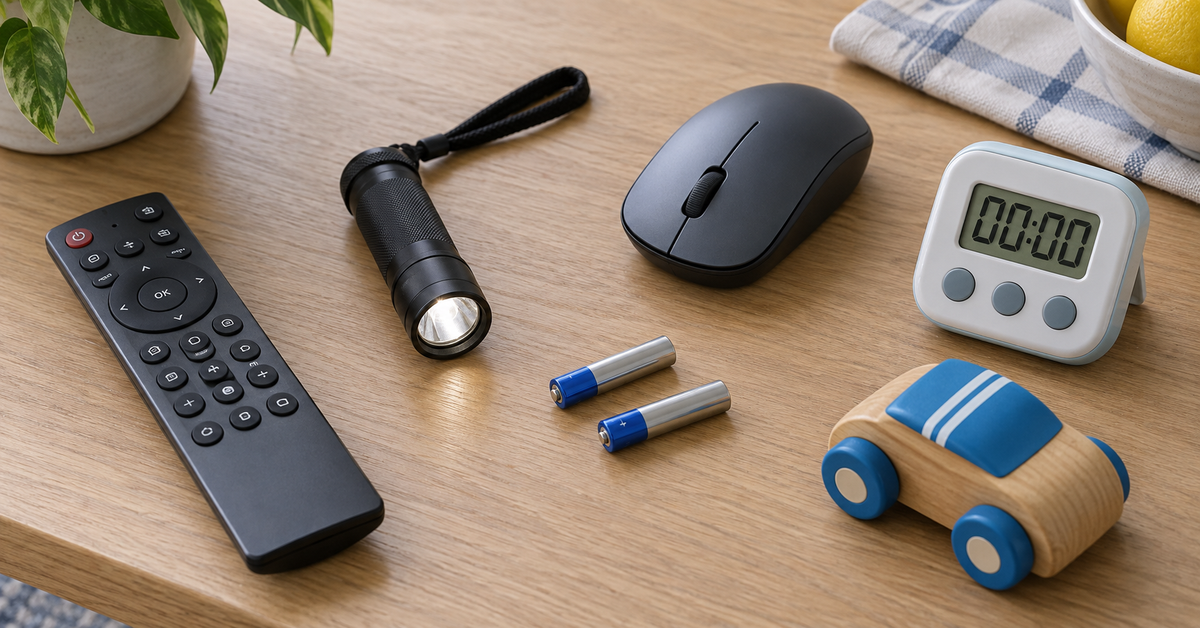
What uses AAA batteries? Common examples include TV and streaming remotes, small flashlights, wireless mice and keyboards, digital thermometers, kitchen timers, bathroom scales, toys, game controllers, LED decorations, and some smart-home sensors. The exact battery varies by model, so check the battery compartment, device label, or manual before buying replacements.
AAA, also called triple-A, describes a battery size—not a single chemistry. Alkaline, primary lithium, and rechargeable NiMH AAA batteries can share similar dimensions while having different voltage and performance characteristics.
Common Things That Use AAA Batteries
| Device category | Common examples | What to check |
|---|---|---|
| Remote controls | TV, streaming-device, soundbar, fan, and air-conditioner remotes | Some remotes use AA or coin cells instead, so read the compartment label. |
| Computer accessories | Wireless mice, compact keyboards, presentation remotes, and styluses | Confirm whether the device takes replaceable AAA cells or has a built-in rechargeable battery. |
| Small lights | Penlights, compact flashlights, headlamps, closet lights, and LED decorations | Check battery count and chemistry requirements, especially for high-output lights. |
| Home devices | Kitchen timers, digital thermometers, bathroom scales, clocks, and some doorbell accessories | Do not assume every alarm, detector, thermostat, or doorbell uses AAA batteries. |
| Toys and games | Small electronic toys, handheld games, game controllers, and learning devices | Follow the toy maker's age, battery-type, polarity, and adult-supervision instructions. |
| Personal-care devices | Some electric toothbrushes, grooming tools, facial brushes, and travel accessories | Many newer models use built-in batteries; verify before purchasing cells. |
| Smart-home accessories | Some temperature sensors, contact sensors, keypads, and monitoring accessories | Smart devices often have model-specific voltage and chemistry requirements. |
This list is a starting point, not a compatibility guarantee. Two products in the same category can use different battery sizes or power systems. If you are checking a remote, our remote-control battery size guide explains how to distinguish AAA, AA, and coin cells.
What Is an AAA Battery?
An AAA battery is a small cylindrical cell. Standard AAA dimensions are approximately 44.5 mm long and 10.5 mm in diameter, although permitted manufacturing tolerances apply. It is smaller than an AA battery and cannot be treated as an interchangeable substitute.
Battery markings may also include designations such as LR03 for alkaline AAA or HR03 for rechargeable NiMH AAA. Always match the device maker's stated size, voltage, chemistry, and rechargeability requirement rather than relying on appearance alone.
AAA Battery Voltage and Chemistry
| AAA battery type | Typical nominal voltage | Rechargeable? | Practical note |
|---|---|---|---|
| Alkaline AAA | 1.5V | No | Common in low-drain household devices when permitted by the manufacturer. |
| Primary lithium AAA | 1.5V | No | Single-use lithium chemistry; never place it in a charger. |
| NiMH AAA | 1.2V | Yes | Useful for compatible frequently used devices; charge only with a compatible NiMH charger. |
| Regulated rechargeable lithium AAA | Often labeled 1.5V | Yes | Uses internal electronics and a product-specific charging system; do not assume universal compatibility. |
Nominal voltage is only part of the decision. A device designed for 1.5V primary cells may not behave the same way with 1.2V NiMH cells, while a device that supports NiMH may work well with them. Follow the device manual when requirements differ.
How to Choose AAA Batteries for a Device
- Confirm the size. Look for AAA, LR03, HR03, or another designation on the compartment or in the manual.
- Check the required voltage and chemistry. Do not assume that every AAA-shaped cell is electrically interchangeable.
- Confirm whether rechargeable batteries are allowed. Use rechargeable cells only in devices that accept them, and use the charger specified for that battery chemistry.
- Replace complete sets together. Use batteries of the same brand, chemistry, and age unless the device maker states otherwise. For rechargeable sets, start with cells at a similar state of charge.
- Follow polarity markings. Match the positive and negative ends shown inside the compartment.
For compatible devices that call for single-use 1.5V lithium AAA cells, BEVIGOR's current product page lists its AAA lithium batteries as 1.5V and 1200mAh. Review the device instructions and the current BEVIGOR AAA lithium battery specifications before purchasing.
For compatible devices that accept 1.2V NiMH cells, see the current BEVIGOR rechargeable NiMH AAA specifications. A product page is not a substitute for the device manufacturer's compatibility instructions.
When AAA Batteries Are Not the Right Choice
Do not install AAA batteries merely because they fit loosely or can be adapted to a larger compartment. AA, AAAA, button cells, proprietary packs, and built-in rechargeable batteries have different dimensions and electrical characteristics.
Safety-critical products deserve extra care. Smoke and carbon-monoxide alarms, medical devices, security equipment, and children's products can have exact battery requirements. Use only the battery type and replacement procedure specified by the manufacturer.
AAA Battery Storage, Use, and Disposal
- Keep batteries in their original packaging or another arrangement that prevents terminals from contacting metal objects.
- Do not mix old and new batteries or different chemistries in the same device.
- Do not recharge a battery labeled non-rechargeable.
- Remove depleted batteries promptly and follow the device maker's instructions for long-term storage.
- Keep batteries and devices with accessible cells away from children.
Disposal rules differ by chemistry and location. The US Environmental Protection Agency recommends checking local or state solid-waste guidance and using appropriate collection or recycling options for rechargeable and lithium batteries. See the EPA household battery guidance for current information.
Frequently Asked Questions
What household items use AAA batteries?
Common examples include remote controls, compact flashlights, wireless mice, kitchen timers, digital thermometers, bathroom scales, small toys, and LED decorations. Check each model because similar devices may use AA, coin cells, or built-in rechargeable batteries instead.
Are triple-A and AAA batteries the same?
Yes. “Triple-A” is the spoken name for the AAA battery size.
Do all remote controls use AAA batteries?
No. Many use AAA cells, but others use AA batteries, coin cells, or built-in rechargeable batteries. Read the compartment label before buying replacements.
Can I use rechargeable AAA batteries instead of alkaline?
Only when the device manufacturer permits them. NiMH AAA batteries are commonly rated 1.2V, while alkaline AAA batteries are nominally 1.5V, so device behavior can differ.
Can I mix lithium, alkaline, and rechargeable AAA batteries?
No. Use a matched set with the same chemistry, brand, age, and state of charge, following the device instructions.
Bottom Line
AAA batteries commonly power compact household electronics such as remotes, small lights, wireless accessories, timers, toys, and some sensors. The category name alone does not confirm compatibility. Check the device label for the correct size, voltage, chemistry, battery count, and rechargeability before replacing a set.






Share:
Why Should You Use Lithium AA Batteries in Hunting Cameras?
Lithium AA vs Lithium AAA Battery: What’s the Real Difference?