

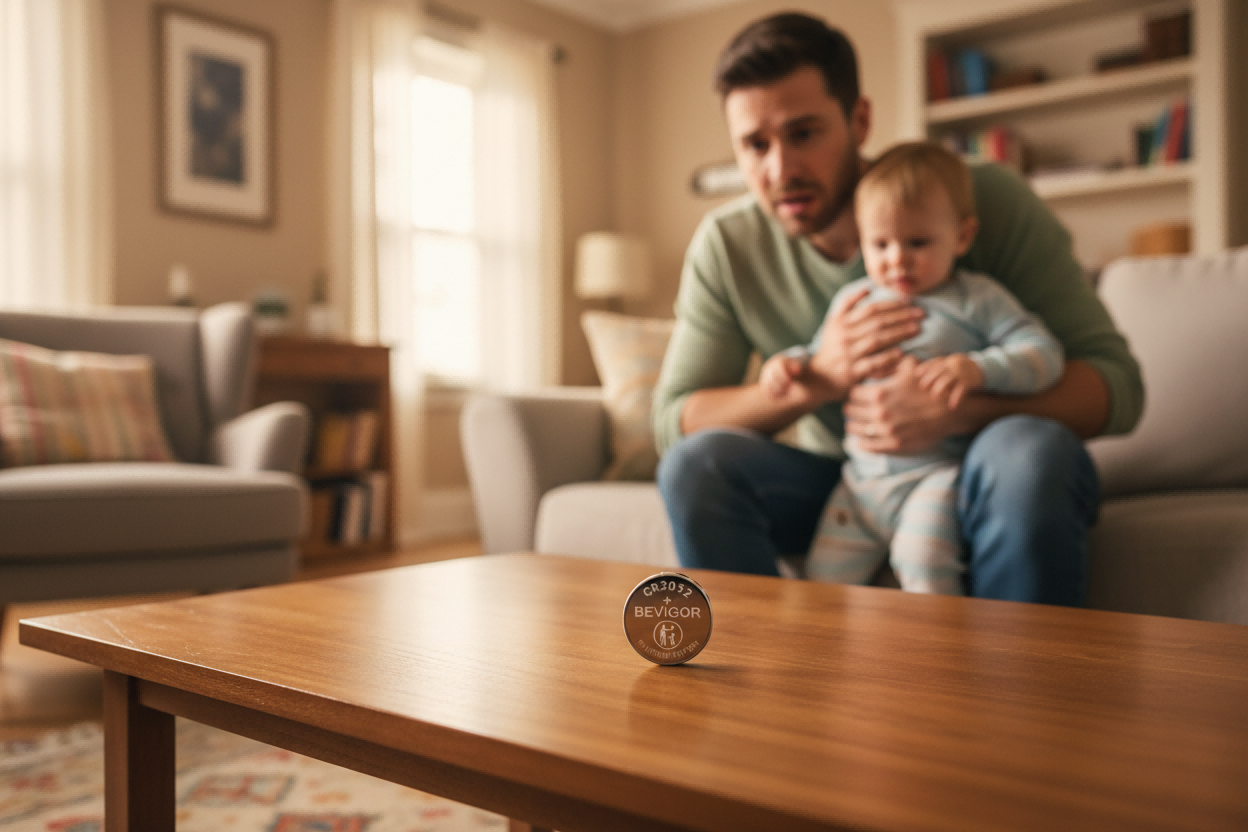
Reese's Law mandates child-resistant packaging for button and coin batteries to prevent deadly childhood ingestion. However, these safety packaging rules can create accessibility challenges for seniors and people living with arthritis. Regardless of how secure the packaging is, accidents can still happen, making immediate recognition and fast action critical.
If you suspect a child has swallowed a button battery, treat it as a medical emergency. Do not wait for physical symptoms to appear before seeking professional care. Severe internal tissue burns can begin in as little as two hours, even if the child acts completely fine.
1. Immediate Steps for Suspected Button Battery Ingestion
When a button battery becomes lodged in the throat or esophagus, saliva triggers an electrical current that causes severe chemical burns. You must contact emergency services or go to the nearest emergency room immediately.

A strong starting point for immediate guidance is Poison Control's button-battery emergency instructions, which outline key hotline numbers and critical timeframes. Calling 1-800-222-1222 or the National Battery Ingestion Hotline at 1-800-498-8666 connects you with experts right away.
|
Action Required |
Immediate Protocol |
Crucial Warning |
|
Call Emergency Services |
Dial 911 or head to the nearest emergency room |
Do not delay transport to observe the child |
|
Contact Poison Control |
Call 1-800-222-1222 or 1-800-498-8666 for expert triage |
Provide battery size or model code if known |
|
Prevent Oral Intake |
Withhold all food and liquids (except honey if eligible) |
Giving the wrong liquids can accelerate chemical reactions |
2. Understanding Poison Control Triage Guidance and Honey Rules
Poison Control provides detailed, step-by-step triage guidance for button battery ingestion, including specific rules on administering honey while traveling to emergency care. Honey acts as a protective physical barrier, coating the battery to slow down harmful chemical reactions.
For the most detailed and up-to-date instructions, refer directly to Poison Control's button-battery triage guideline. According to medical protocols, honey should only be given if the child is over 12 months old, swallowed the battery within the past 12 hours, and can swallow safely. Give 2 teaspoons (10 mL) of honey every 10 minutes en route to the hospital, up to 6 doses.
Never give honey to an infant under one year old due to the risk of infant botulism. Additionally, do not give honey if the ingestion occurred more than 12 hours prior or if the child cannot swallow.
Pro Tip: If there's a realistic chance a battery went into a mouth, don't "wait for symptoms." Many of the most serious injuries start internally long before outward signs appear.
3. What NOT to Do During a Button Battery Emergency
When facing an emergency, caregivers understandably want to take immediate action at home to help. However, attempting unverified first aid methods can significantly increase the risk of injury.
My friend John recently shared his experience with a suspected button battery scare when his toddler handled a small remote control. He immediately called Poison Control rather than trying home remedies, allowing paramedics to evaluate his son safely and quickly without added complications.
|
Prohibited Action |
Risk to the Child |
Correct Alternative |
|
Inducing Vomiting |
Re-exposes the esophagus to caustic tissue damage |
Keep the child calm and still |
|
Giving Food or Water |
Triggers saliva production and accelerates electrical burns |
Withhold food and drink completely |
|
Delaying Medical Care |
Allows deep tissue perforation to progress internally |
Proceed directly to the nearest emergency room |
Avoid inducing vomiting or attempting home fixes. Follow expert triage instructions and seek immediate medical evaluation.
4. How to Handle a Button Battery Inserted in the Ear or Nose
Children frequently explore objects by placing small items into their noses or ears. When a button battery is inserted into these nasal or auditory passages, it poses severe risks similar to oral ingestion.
Moisture in the nasal mucosa or ear canal interacts with the battery's electrical poles, causing localized tissue necrosis, cartilage damage, or hearing impairment. If you suspect a battery is in the ear or nose, treat it as a medical emergency.
Do not attempt to extract the battery with tweezers or cotton swabs, as this can push it deeper into the nasal cavity or ear canal. Seek urgent emergency medical guidance immediately.
Poison Control's resources cover both ingestion and batteries inserted in the nose or ear as urgent scenarios requiring rapid clinical intervention.
5. Preventing "Battery Drawer Chaos" and Accidental Swallowing
Managing small household electronics across multiple devices can lead to cluttered drawers filled with mixed batteries. This disorganization increases the risk of children finding loose cells or caregivers inserting the wrong size into sensitive equipment.
Here’s the safe battery management guideline provided by Bevigor battery experts.
|
1. AUDIT DEVISE |
Identify all household items that use button cells and secure their compartments with screws. |
|
2. SAFE STORAGE |
Keep spare cells in child-resistant blister packaging in a locked, elevated location. |
|
3. ORGANIZED MATCHING |
Use size guides to avoid drawer chaos and prevent mixing fresh and spent batteries. |
|
4. TAPED DISPOSAL |
Cover battery poles with tape before placing them in a secure recycling container. |
When managing devices for multiple family members, a quick refresher, such as a hearing aid battery size guide (312 vs 13), can reduce confusion and prevent unnecessary "battery drawer chaos."
By keeping your battery storage organized, elevated, and locked away, you can protect your household while ensuring easy accessibility for daily maintenance.






Aktie:
How Child-Resistant Retail Changes Affect the Elderly Hearing Community
Safe Storage Systems for Household Coin Batteries: Habits That Beat Packaging