

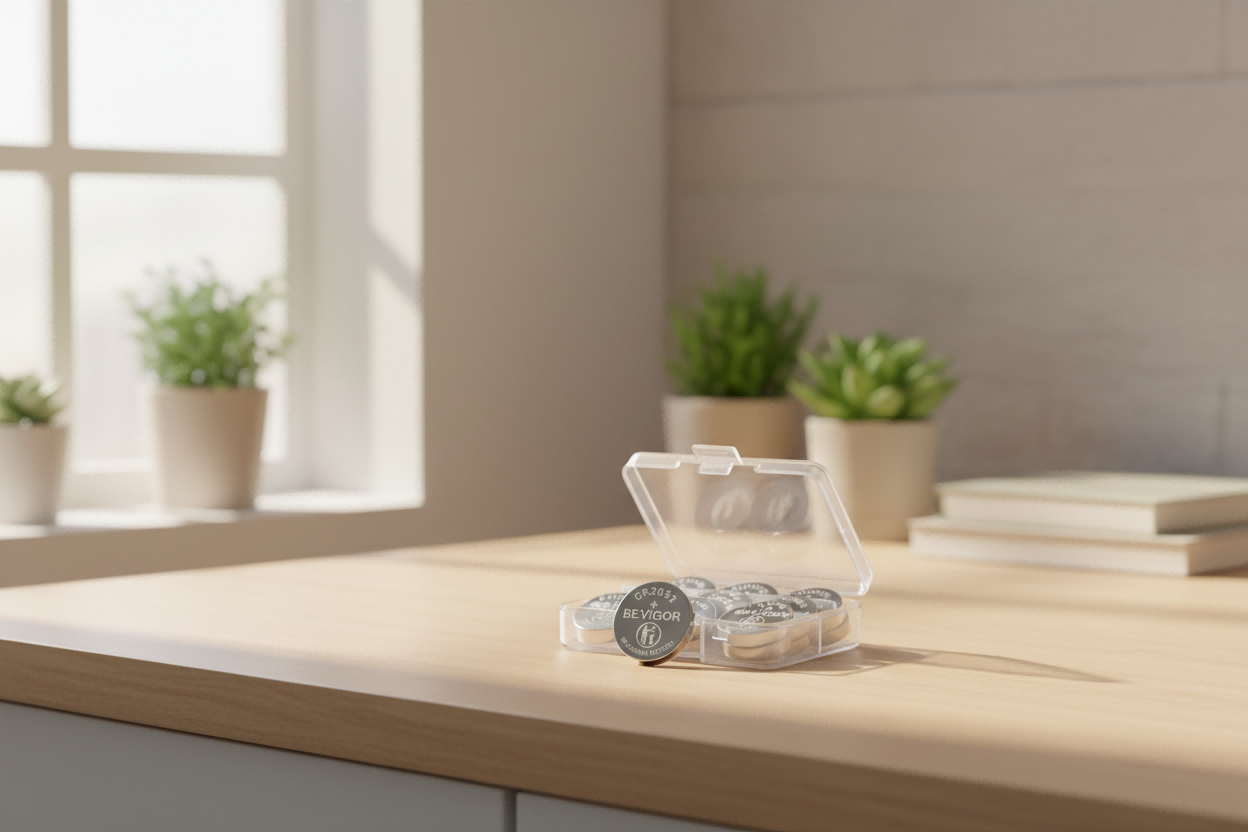
Reese's Law mandates child-resistant packaging for button and coin batteries to prevent deadly childhood ingestion, but creates accessibility challenges for seniors and people living with arthritis. Beyond relying on safe bulk packaging of batteries, families need long-term systems based on proactive habits. Establishing structured storage rules, treating spent cells as hazardous waste, and eliminating battery scatter help ensure maximum safety for children without creating friction for adults.
1. Implementing a Two-Layer Storage Rule for Every Household Battery
Child-resistant packaging serves as an essential first line of defense against accidental ingestion. However, packaging alone cannot prevent every household accident if loose cells remain accessible on low counters.
To guarantee maximum protection in homes with young children, safety experts recommend establishing a strict two-layer storage rule. This systematic approach creates redundant physical barriers that protect vulnerable family members even when daily routines are disrupted.

Securing Fresh Batteries in Elevated Cabinets
The first layer of defense requires keeping every new cell inside its original packaging or within a heavy-duty storage case. Factory packaging uses puncture-resistant plastic laminates engineered to resist a child's teeth and fingers.
Maintaining this primary protective layer ensures that even if a child obtains a package, they cannot easily extract the small cell inside.
Choosing Safe Storage Containers for Household Batteries
The second layer involves placing that primary package inside a dedicated high cabinet or locked drawer. This location should be at least five feet off the ground, well out of reach and sight of curious toddlers.
Combining child-resistant packaging with elevated storage establishes a fail-safe environment. Even if a cabinet is left unlatched, primary packaging continues to provide immediate protection against accidental ingestion.
|
Storage Pipeline Layer |
Physical Container Requirement |
Primary Household Safety Objective |
|
Layer 1: Primary Barrier |
Factory child-resistant pack or heavy-duty latching case |
Prevents direct physical access to individual metallic cells |
|
Layer 2: Secondary Location |
High cabinet (5+ feet) or locked storage drawer |
Keeps the entire inventory out of sight and reach of young children |
2. Managing Used Coin Batteries as Hazardous Waste
A common misconception among consumers is that a depleted or "dead" cell no longer poses a physical hazard. In reality, a cell lacking sufficient voltage to power a device often retains significant residual charge.
When swallowed, even a depleted lithium cell can complete an electrical circuit in the esophagus. This triggers an electrochemical reaction generating hydroxide ions, causing severe chemical burns in as little as two hours.
Preventing Electrical Shorts in Spent Coin Batteries
Because depleted cells retain residual voltage, storing them loosely together in an open container creates serious electrical risks. Uninsulated metallic surfaces can touch, creating short circuits that generate heat or drain remaining energy unpredictably.
My friend Fred learned this lesson after storing loose cells together in a plastic tub. He discovered that when uninsulated terminals touch inside a container, residual energy drains rapidly, increasing heat risks and creating unnecessary battery clutter.
Safe Disposal Methods for Expired Batteries
To manage spent cells safely, place them immediately into a small container featuring a tight-fitting, child-resistant screw top. For added safety, cover both positive and negative terminals of each cell with non-conductive electrical tape before disposal.
Keep this disposal container in an elevated, secure location until you can transport collected cells to an authorized municipal recycling center. Promptly removing depleted cells eliminates lingering ingestion hazards.
3. Identifying Battery Scatter Across Common Household Devices
While caregivers frequently focus on securing spare packaging, they often overlook dangers posed by everyday household products. Small power cells are embedded in dozens of common items, creating a widespread hazard known as battery scatter.
When products lack screw-secured compartments, a simple drop onto a hard floor can pop the cover open, exposing tiny metallic cells to young children.
Scanning Daily Objects for Accessible Coin Batteries
To eliminate battery scatter, conduct a systematic safety audit of every room. Inspect high-risk items, including television remotes, flameless LED candles, digital bathroom scales, singing greeting cards, automotive key fobs, and small illuminated toys.
These everyday objects are often left on low coffee tables or floors, making them easily accessible to crawling infants and pets.
Securing Compartments on Every Electronic Battery Device
If an inspection reveals a device with a loose cover, treat the entire product as an active hazard. Secure weak battery doors with heavy-duty tape or, if allowed, insert a retention screw.
|
Household Product Category |
Common Compartment Vulnerability |
Recommended Safety Remediation |
|
TV Remotes & Key Fobs |
Snap-on covers that open upon impact |
Wrap the seam with heavy-duty tape or replace it with screw-secured models |
|
Flameless LED Candles |
Twist-lock or friction-fit bottom covers |
Store on high mantels or secure bases with reinforced tape |
|
Bathroom Scales & Cards |
Exposed slide-out trays or paper backing |
Keep scales stored vertically and discard singing cards after use |
4. Decoding Coin Battery Size Codes to Prevent Storage Chaos
Purchasing mismatched power cells without a plan leads to cluttered drawers filled with loose, unidentified batteries. This disorganization increases the likelihood that loose cells will scatter across living areas or get mixed up during maintenance.
Understanding standard battery nomenclature allows households to buy intentionally, store systematically, and maintain precise control over inventory.
Understanding Size Codes for Coin Batteries
Lithium coin cells follow a standardized International Electrotechnical Commission designation system defining physical dimensions. In a CR2032 cell, "CR" indicates lithium manganese dioxide chemistry, "20" specifies a 20 millimeter diameter, and "32" indicates a 3.2 millimeter thickness.
Learning these technical codes prevents impulse buying and eliminates chaotic stockpiles. For a plain-English explanation, read how coin battery size codes work.
Organizing Device Power Supplies with Battery Guides
Managing specialized medical equipment, such as hearing aids, requires similar discipline. Different hearing aid models require specific cell sizes, such as Size 312 or Size 13, featuring distinct voltage outputs.
When managing devices for family members, reviewing a hearing aid battery size guide (312 vs 13) reduces confusion and prevents drawer clutter. Storing each size in labeled compartments ensures fast, stress-free replacement.
5. Building Safe Daily Habits Around Your Household Batteries
Establishing robust daily habits offers far greater long-term protection than relying on child-resistant packaging alone. While physical security standards under Reese's Law provide crucial protection, consistent household protocols eliminate hazards at the source.
Combining elevated two-layer storage, taped terminal disposal, and routine device audits creates an environment where accidental ingestions are virtually impossible.
Establishing Long-Term Systemic Battery Safety
Maintaining an organized power management system also resolves accessibility dilemmas faced by older adults and people living with arthritis. When batteries are stored intentionally in designated containers, seniors do not have to fight messy drawers during replacements.
Caregivers can assist by arranging accessible workstations equipped with cutting tools, ensuring safety never compromises personal independence.
Protecting Vulnerable Family Members from Batteries
Protecting your household requires constant vigilance and proactive habit-building. By auditing everyday electronics, isolating spent cells, and understanding size specifications, you protect children from severe internal burns while maintaining an efficient power system.
At Bevigor, we remain committed to empowering families with expert safety guidance, ensuring every device operates smoothly and safely.
Conclusion
Creating a safe home environment requires a comprehensive approach extending beyond child-resistant packaging. By implementing a strict two-layer storage rule, treating spent cells as hazardous waste, and auditing household devices, families can effectively eliminate the risk of battery ingestion.
Understanding technical size codes further prevents drawer chaos, making battery management simple and organized for caregivers and seniors alike. Sustainable safety relies on daily habits—protect your loved ones by establishing secure storage protocols today.






Share:
What to Do If a Child Might Have Swallowed a Button Battery
Child Safety Laws vs Accessibility: Reese's Law and the New Reality of Button Battery Packaging